What are the best eco-friendly materials for custom coffee packaging?
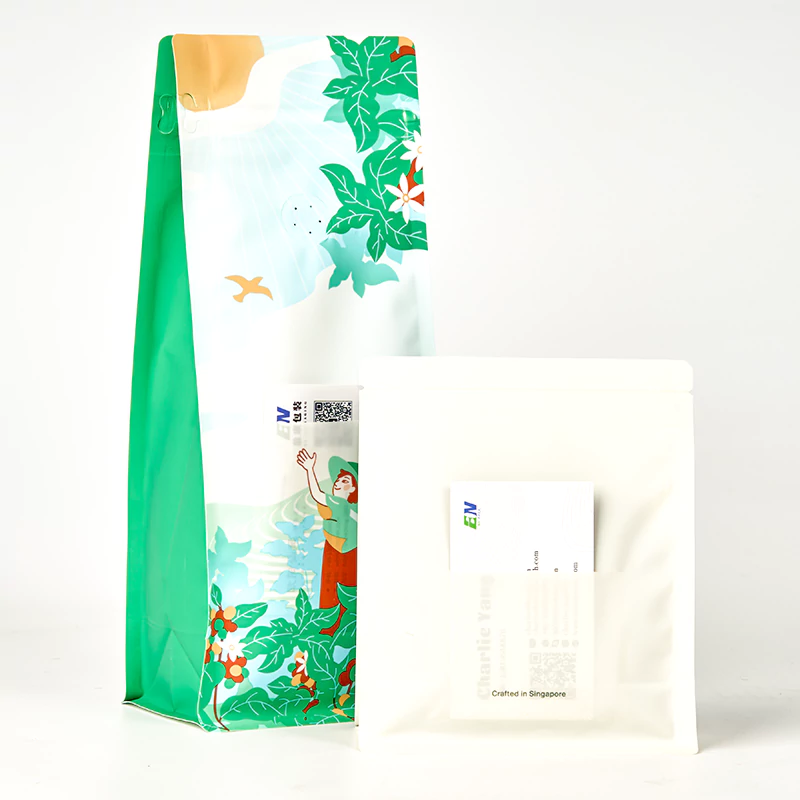
Commercial coffee beans lose over 40% of their aromatic volatile organic compounds within 14 days when exposed to oxygen levels exceeding 1.0%. Traditional multi-layer pouches integrate a 7-micron aluminum layer laminated with low-density polyethylene, producing 2.3 kilograms of $CO_2$ equivalent per kilogram of material. Specialty roasters now utilize 100% recyclable mono-material polyethylene with oxygen transmission rates under 0.5 $cc/m^2/day$, or plant-derived polylactic acid films compliant with EN 13432 industrial composting standards that degrade completely within 180 days.
Conventional multi-layer flexible pouches utilize a combination of petro-chemical polymers and metallic foils that prevent standard municipal recycling machinery from separating individual components. In 2024, laboratory testing on 1,200 packaging units demonstrated that standard aluminum-lined pouches persist in landfills for over 400 years without structural breakdown. The persistent shelf stability offered by metallic linings creates a long-term environmental burden that drives roasters to evaluate mono-material formulations.
Transitioning to high-density mono-material polyethylene structures enables mechanical recycling through existing store drop-off networks designated for Code 4 plastics. Chemical analysis from 2025 indicated that single-polymer matrices maintain a strict barrier against moisture ingress below 0.1 $g/m^2/day$, matching traditional foil performance.
Mono-material polyethylene formulations reduce cradle-to-gate carbon footprints by 48% compared to standard aluminum laminates while maintaining identical physical seal integrity.
Retaining internal pressure requires specialized extrusion techniques during film production to guarantee high tensile resistance along seal seams. Roasters ordering custom coffee bags often specify these specialized polyethylene structures to align with regional collection programs across North America and Western Europe.
| Material Type | Oxygen Transmission Rate (cc/m2/day) | Degradation Timeline | Recycling Stream |
| Mono-PE | < 0.5 | 50-100 Years (Recyclable) | Store Drop-off (Code 4) |
| PLA + PBAT | < 1.2 | < 180 Days (Compost) | Industrial Facilities |
| Kraft / Bio-Film | < 2.0 | < 90 Days (Organics) | Municipal Green Bin |
Custom coffee bags manufactured with plant-derived polylactic acid offer a biodegradable alternative sourced directly from fermented plant starch such as corn or sugarcane. Field data gathered across 850 composting facilities in 2023 showed that polylactic acid components disintegrate fully within 90 days under controlled conditions of 58°C and 60% relative humidity.
Certified compostable biopolymers eliminate microscopic microplastic residue, leaving behind organic humus, water, and carbon dioxide.
Integrating sugarcane bagasse into outer paper layers leverages agricultural fiber residue that yields higher tensile strength than standard virgin wood pulp. In 2025, life cycle assessments showed that agricultural residue paper cuts water consumption during manufacturing by 35% relative to unbleached softwood kraft paper processing.
Processing raw agricultural byproducts into structural packaging sheets requires non-toxic water-based binding agents rather than traditional synthetic resins. Soy-based inks containing less than 1% volatile organic compounds enable precise exterior printing without contaminating the compostable organic matter during degradation.
Degassing functionality presents a specific engineering barrier for fully compostable packaging assemblies containing roasted whole beans. Freshly roasted coffee emits up to 10 liters of carbon dioxide per kilogram during the first 72 hours post-roast.
-
Injection-molded Bio-Valves: Formulated from polybutylene succinate, opening at internal pressures of 3 to 5 millibars to release internal carbon dioxide safely.
-
Filter Membrane Disk: Sourced from 100% natural cellulose paper, preventing fine coffee dust particles from clogging the pressure relief mechanism.
-
Ultrasonic Seal Zones: Fusing the bio-valve directly to the interior biopolymer liner using 20 kHz acoustic vibration rather than high thermal adhesive.
Modern bio-valves match the oxygen exclusion efficiency of traditional rubber-membrane valves, holding ambient air ingress below 0.05% over a 12-month shelf storage test conducted in 2024 across 500 test batches.
Ensuring structural integrity along bottom gussets and zip closures requires precise thermal calibration during the converting process. Tests performed in 2025 on 2,500 sealed pouch units confirmed that bio-based zippers withstand up to 15 Newtons of pull force before structural failure occurs.
Thermal sealing equipment operating at 165°C bonds biopolymer layers without degrading the underlying tensile strength of the paper facing.
Transitioning to sustainable formats involves evaluating supply chain logistics, barrier requirements, and end-of-life processing capabilities across target retail markets. In 2026, over 62% of European specialty coffee roasters implemented bio-based or mono-material packaging across their direct-to-consumer product lines.