What 'No Filter' Means in Practice for Character AI Chat
"No filter" is a description of creative latitude, not a claim that nothing is off limits. The platform's own FAQ says that some limitations apply in accordance with its content and community guidelines, so the useful question is not whether rules exist but how much room the broad setting leaves you in an ordinary month.

Key takeaways
- Unfiltered describes the breadth of the catalogue, and the same FAQ that publishes the wording states that content and community guidelines still apply.
- Guardrails are attached to content and conduct rather than to conversational tone, so a wide setting and a rule set coexist.
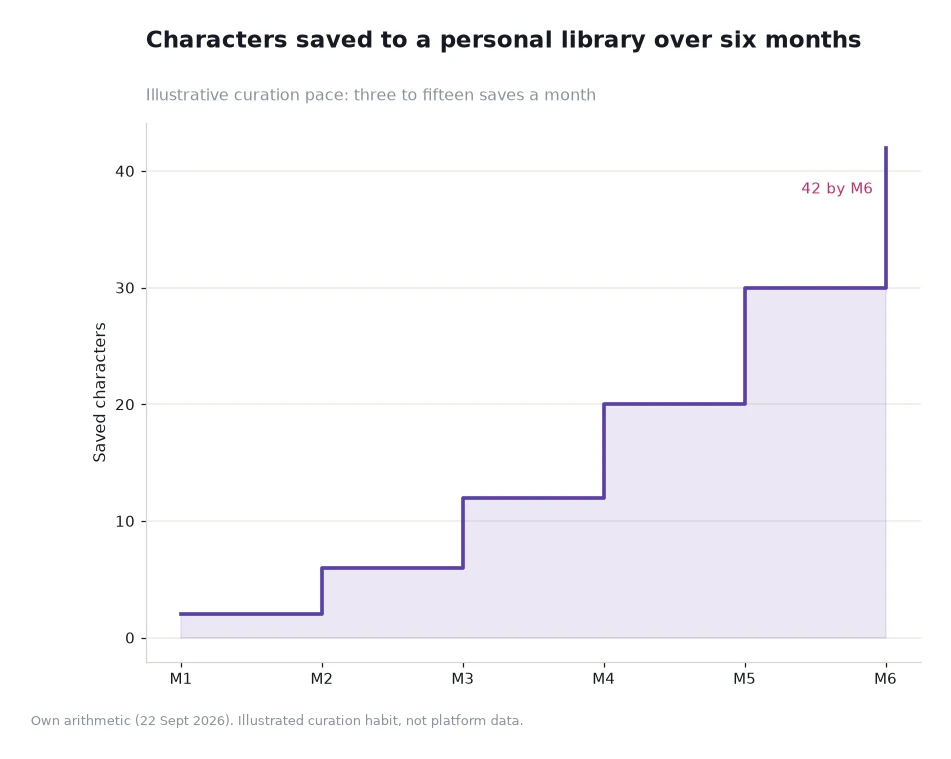
- A wide catalogue is a curation problem: cumulative saves of 2, 6, 12, 20, 30 and 42 across six months is the shape of one honest library.
- Reporting is a first-class feature, not an afterthought — every content page carries a report path and the removal policy explains what follows.
Latitude and limits are two different dials
Read the word carefully. Unfiltered tells you that the browse experience is not narrowed down to a mild subset. It says nothing about which behaviours are permitted inside a conversation, which is why the same page that advertises the broad setting also points readers at a set of guidelines.
The distinction matters when you are deciding whether to invest an evening in a character. Latitude is about selection: how many kinds of character you can find and how specific their framing can be. Limits are about conduct: what the platform will and will not host, and what happens when a piece of content is reported.
There is a third element that people often fold into this discussion by mistake. The site's compliance statement describes its content as AI-generated text and states that no real person is depicted. That is a description of what the catalogue is, not a restriction on how broad it is, and keeping the two ideas separate prevents a lot of confusion.
What the rule set actually governs
Rules of this kind are mostly about hosting rather than about taste. They determine which characters can stay in the catalogue, how quickly a reported item is reviewed, and what a creator can expect when something they published is challenged.
Practically, the mechanisms are visible in three places. Each content page carries a report path, and the same address that handles content reports doubles as the compliance contact. The removal policy explains what a report triggers. The complaints route documents how to escalate when a first response is not the end of the matter.
None of that is unusual for a platform with user-published work, and none of it contradicts the broad setting. A wide catalogue with a working removal path is the normal arrangement; the alternative, a wide catalogue with no reporting at all, is the one that would be worth worrying about.
What a wide catalogue looks like over six months
Breadth is easy to promise and hard to manage. One way to see the shape of the problem is to track how a personal library grows under an illustrative curation pace, which is what the chart below does. The numbers are an assumption rather than platform data: two characters saved in the first month, then four, six, eight, ten and twelve added in the months that follow.
Line the arithmetic up and it reads 2, then 2 + 4 = 6, then 6 + 6 = 12, then 12 + 8 = 20, then 20 + 10 = 30, then 30 + 12 = 42. Six months of moderate saving ends with 42 characters in the library, and the accession rate nearly doubles between the first month and the last. Nothing about the platform created that curve; a wider catalogue simply makes it easier to keep finding something worth keeping.
Worked example: what 42 saves costs in attention
Assume, purely as an illustration, that each saved character received one trial session of 30 minutes before being kept. Seven sessions a month at half an hour each is 3.5 hours a month, and across the six months shown above that is 21 hours of testing in total.
Set that against a lighter pattern of 16 sessions a month at 30 minutes, which is 8.0 hours. The trial load is under half of that, which is the practical reason the curve flattens comfortably rather than becoming a chore. The brakes are the same ones every library has: an unsaved character costs a session and teaches you what to avoid, and a saved one is only worth keeping if a second visit still feels worth the half hour.
The one number worth watching is the ratio of trials to saves. Six trials for one save is fine at 3.5 hours a month and miserable at 20 hours a month, and the only way to notice the difference is to write the two counts down.
| Guardrail | Where it lives | What it means for a session |
|---|---|---|
| Content and community guidelines | The platform FAQ wording accompanying the unfiltered setting | A broad catalogue still ships with a rule set |
| Reporting | A report path on each content page and the public support address | Moderation is partly user-triggered rather than purely automatic |
| Removal process | The content removal policy | Explains what a report sets in motion |
| Escalation | The complaints policy | Documents how a disputed decision is reviewed |
| Age gating | The 18+ state and the compliance statement | Adult access to AI-generated text that depicts no real person |
Reading the front page as a map
The index at https://crushon.ai/ is a fair summary of what the broad setting gives you. The navigation splits into Characters, Memories and Creators; the tag row offers Unfiltered beside Filtered and 18+; and the shelves include Recent Hits and Animated alongside gender filters. Nothing in that layout promises a rule-free environment, and nothing in it suggests a narrow one either.
Two habits follow from that map. First, treat the guardrails as part of the product: the content removal policy tells you how a reported character is handled, and knowing the route is more useful than being surprised by it. Second, treat breadth as a curation problem, because a catalogue that wide will keep offering new candidates whether or not the current library is working.
Crushon is explicit about the second half of that trade-off: an unfiltered catalogue is paired with a moderation layer rather than replacing it. Read as a whole, the setting is generous about what you may explore and specific about what the platform will host.
Frequently asked questions
Does unfiltered mean there are no rules at all?
No. The platform states that some limitations apply in accordance with its content and community guidelines, so a wide catalogue and a rule set operate together.
What should I do if a character breaks those rules?
Use the report path on the content page; the removal policy explains what happens next and the complaints policy covers escalation.
Is the content made from photographs or recordings?
No. The site describes its content as AI-generated text and states that no real person is depicted, which is what the compliance statement covers.
Treat breadth as a budget
A wide catalogue rewards a plan. Save fewer characters and revisit them more often, keep the trial-to-save ratio in view, and let the guardrails do their job without treating them as a contradiction of the setting. If the library starts growing faster than you can revisit it, the fix is a smaller library rather than a narrower catalogue.
Data and sources: the unfiltered setting, the guidelines wording and the navigation structure shown on CrushOn.AI[1], read 22 Sept 2026. The six-month save curve and the 30-minute trial session are illustrative assumptions, not platform data. Written for an adult audience, 18 and over.