From Quote to Delivery: Evaluating particle board suppliers
Evaluating particle board suppliers from quote to delivery requires a controlled product definition and evidence that follows the order. The buyer should align panel construction, dimensions, finish, compliance documents, samples, production controls, packaging, and acceptance criteria before comparing price. A disciplined handoff makes it easier to see whether suppliers are offering the same product and what must be verified before shipment.
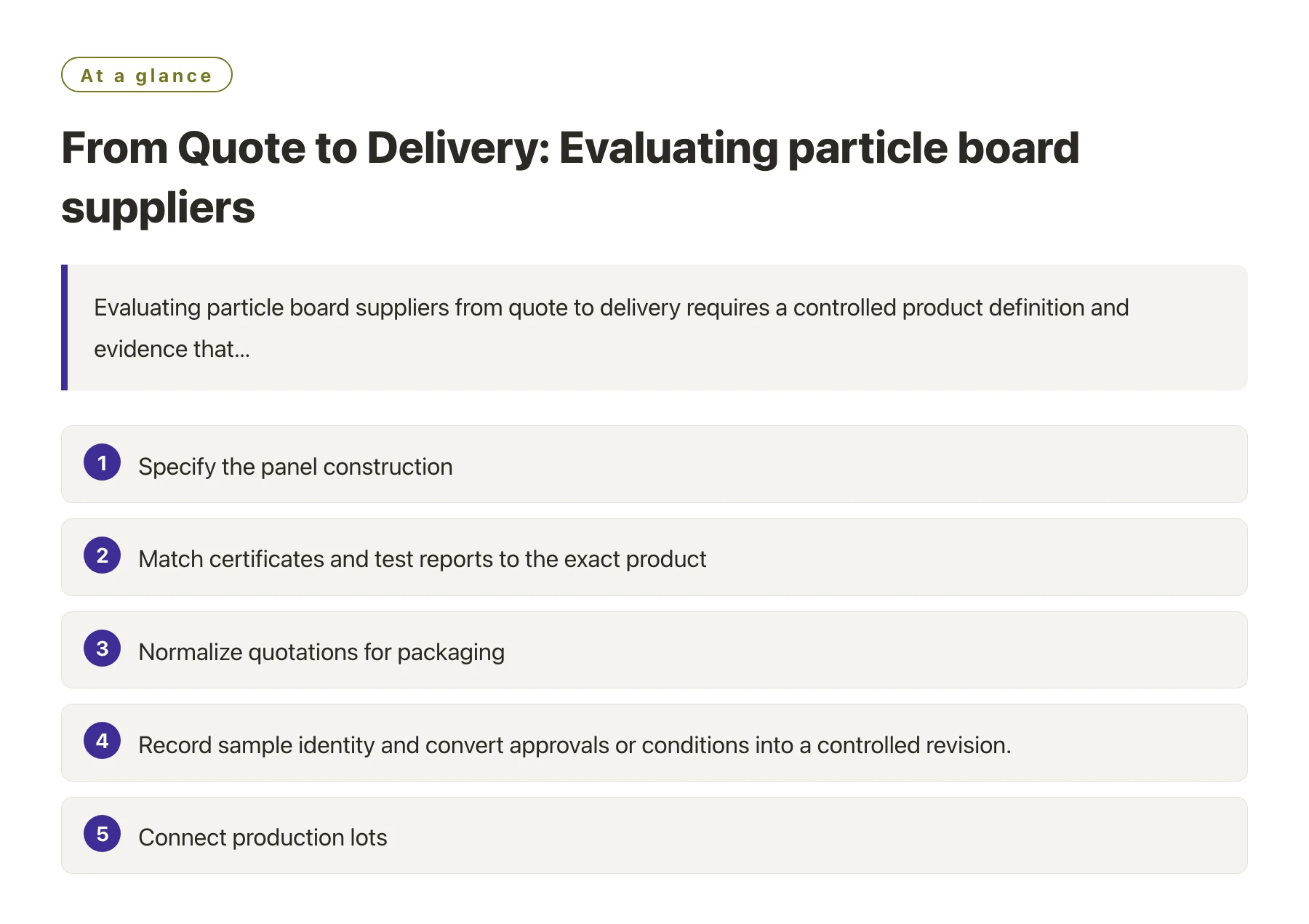
Key takeawaysSpecify the panel construction, dimensions, finish, tolerances, and intended application. · Match certificates and test reports to the exact product, plant, construction, and market. · Normalize quotations for packaging, processing, delivery basis, lead time, and exclusions. · Record sample identity and convert approvals or conditions into a controlled revision. · Connect production lots, inspection results, labels, and shipment documents.
Particleboard is used in furniture, fixtures, and other interior applications, but the name alone does not capture performance or compliance needs. The useful question is whether the quoted panel, evidence, and delivery plan match the finished product and destination market. The sections below provide a sequence for making that comparison.
Define the panel before requesting comparable quotes
Particleboard is not a single interchangeable grade. A quote needs the intended use, panel dimensions, thickness tolerance, density or other buyer-selected property, surface condition, edge quality, and any machining or lamination that changes the finished component. State whether the panel will remain exposed, receive a decorative finish, be cut into parts, or carry hardware. Those details affect what a supplier should price and which sample represents the order.
Build one controlled specification and send the same revision to every candidate. Include drawings, allowable substitutions, packaging, destination, expected order range, and target delivery window. Mark which parameters are mandatory and which can be offered as alternatives. Ask each supplier to list exceptions beside the affected requirement; this prevents a low price from concealing a different construction or finish assumption.
Clarify how a grade name is being used. A commercial label may not define the exact test method, thickness range, loading condition, or appearance tolerance. Ask for the standard or internal specification behind the claim and decide whether it fits the application. If requirements are not final, identify the open decision and avoid treating the first quotation as a fixed technical commitment.
Review materials, construction, and evidence
Ask the supplier to identify furnish or core construction, resin system where relevant, face layers, and any overlay or veneer. Request a current technical data sheet tied to the offered product and factory. If a certificate or test report is part of the decision, check the product scope, sample identity, test date, laboratory or certifier, and whether the document applies to the same thickness and construction. A document bearing a supplier name alone may not cover the panel actually quoted.
For composite wood products entering the U.S. market, EPA identifies particleboard among the product types regulated under TSCA Title VI and describes testing, certification, labeling, and recordkeeping provisions.[1] The applicability to a particular panel or finished article depends on the product and transaction details. Ask the importer or regulatory owner to confirm current obligations and obtain the evidence required for the exact product; do not assume a generic claim of “compliant” resolves every downstream responsibility.
Keep the distinction between a production control and a market compliance document. A factory test may help monitor consistency, while a third-party certification or shipment statement may be required for a particular regulated product. Record who supplies each document, when it is due, and how it will be matched to the purchase lot.
Compare quotations on a normalized basis
Create a side-by-side table for panel size, thickness, tolerance, grade definition, finish, moisture or conditioning assumptions, packaging, minimum order, tooling, price basis, validity, payment, lead time, and exclusions. Use the same unit of measure and currency. If one supplier quotes loose panels and another quotes protected bundles, request a normalized price and note the packaging differences rather than treating the totals as equivalent.
Check whether the offered price includes sorting, edge preparation, cutting, labeling, testing, pallets, export packing, or delivery to a named point. Ask for a breakdown when an omitted item could affect the landed cost or product performance. For any alternative material or construction, show the change in a separate line so a buyer can compare it without losing the original requirement.
Ask each supplier to state capacity assumptions and the date from which its lead time runs. Clarify whether a schedule begins after deposit, final artwork, sample approval, or another milestone. A short lead time based on unapproved specifications is not directly comparable with a schedule that includes production approval and inspection.
Use samples to test the intended application
Define what the sample needs to prove. A small cut piece may show surface appearance, but not full-panel flatness, packaging damage, or performance after machining. Use a representative sample of the proposed construction and record its source, date, dimensions, finish, and revision. When several plants or lines are involved, identify which production source the sample represents.
Prepare acceptance observations before the sample arrives. Depending on the project, the team may check measured dimensions, surface defects, edge behavior after cutting, screw or hardware fit, bonding with the chosen finish, or consistency across multiple panels. Select methods that match the actual use and competent reviewers. A sample review should not imply a performance claim beyond what was observed.
If the sample is accepted with conditions, list them explicitly and attach them to the controlled specification. Identify any required correction and request a revised sample where needed. Keep rejected samples or photographs with a brief reason so the supplier understands the gap and the buyer does not later compare production to a different reference.
Confirm production controls, packaging, and lot traceability
Before production, verify the factory and production line that will make the order. Ask how incoming furnish and resin are identified, how panel dimensions and surface defects are monitored, how nonconforming output is segregated, and how finished bundles are labeled. The goal is to understand the control path and records available, not to accept an unsupported promise that every panel will be perfect.
Agree how changes are handled. A change to furnish source, resin, press settings, panel construction, finishing line, or subcontractor can affect characteristics important to the order. Require notice, impact evidence, and buyer approval when specified. Tell the supplier which changes require a new sample or test and which can be recorded as routine process adjustments under an agreed control plan.
Packaging should protect panel edges and faces through handling and transport. Specify bundle count, corner protection, moisture protection where needed, pallet dimensions, labels, and handling marks. Define the lot identifier and require shipment documents to connect each bundle to the relevant production record. For long panels, consider unloading equipment and warehouse access before accepting a pallet or bundle configuration.
Manage inspection and shipment release
Choose inspection timing that can catch a problem while correction is still practical. A pre-production review can confirm materials and sample status; an in-process visit can check critical setup; a pre-shipment inspection can examine the finished lot and shipping preparation. Each visit should use a written scope with sample basis, measurements, photographs, defect definitions, and reporting deadlines.
Inspection does not replace the specification or required documentation. State what constitutes a hold, what evidence supports release, who may approve a deviation, and how a failed result is corrected and retested. Keep results tied to the lot and specification revision. If a concern appears, contain the affected units and investigate whether other bundles share the same process or material.
For sourcing coordination on building products, a buyer may review JS Sourcing building materials sourcing while keeping panel grade, market compliance, technical acceptance, and final release decisions with the responsible product and quality owners. A clear handoff connects supplier communication to the buyer’s own purchase controls.
Sources
Frequently asked questions
What should a particle board quotation specify?
It should identify construction, dimensions, tolerances, finish, grade basis, packaging, quantity, price basis, delivery point, lead time assumptions, and exclusions. Ask for deviations against the same controlled specification.
Does one approved sample prove the whole order will conform?
No. A representative sample helps define the product and can reveal issues, while production controls, lot records, and an agreed acceptance check provide evidence for the manufactured order.
What documentation should be checked for U.S.-bound composite wood?
Confirm the specific product and transaction with the responsible regulatory owner. EPA describes TSCA Title VI requirements for covered composite wood products, including particleboard; match any certification, labels, and records to the exact product and applicable role.
When should a supplier change require buyer review?
Review changes that can affect specified construction, performance, finish, traceability, or compliance. State notice and approval triggers in the purchase plan, and request supporting evidence or a new sample when appropriate.