Paying for Acceleration With BTC, BCH or LTC
A fee you cannot pay is the same as no fee at all, which is why the paid acceleration path accepts three currencies — BTC, BCH and LTC — and debits the charge straight from the account balance instead of asking for a second on-chain transaction. That last detail matters more than it looks: if the fee had to arrive by transfer, it would need its own confirmation, and a transaction waiting on a confirmation cannot rescue a transaction waiting on a confirmation. At a BTC price of $84,692, a 0.00004 BTC charge is $3.39, or 0.0571 LTC at $59.32, or 0.0130 BCH at $261.48.[1]

Key takeaways
- Paid acceleration is settled in BTC, BCH or LTC, with the charge taken directly from account assets rather than broadcast as a new transaction.
- The free tier covers transactions of 0.5 KB or less at a fee rate of at least 0.0001 BTC/KB, with quota refreshed hourly and requests handled in submission order.
- Currency choice is a portfolio decision: 0.00004 BTC of charge is $3.39, the same value as 0.0571 LTC or 0.0130 BCH at listed prices.
- A submission is final. It cannot be cancelled, the charge is not refunded, double-spend transactions are not supported, and any transaction with unconfirmed inputs is rejected outright.
The core idea
Acceleration buys a place in a specific operator's next block. The submission is valid only if the transaction is structurally eligible and the operator mines a block soon; until then, the transaction waits in the mempool like everything else. What the paid route changes is not the network's capacity but the queue you are standing in.
The payment mechanism follows from that. Because the charge is deducted from account assets, you need an account that already holds the currency you want to spend — which is the practical reason mining income and fee payment live in the same place for most operators. ViaBTC's wallet holds balances in multiple coins, with deposit, withdrawal and auto conversion sitting next to the mining dashboard.[2]
Three currencies rather than one also removes a conversion step for miners who are paid in more than one asset. A machine on LTC/DOGE merged mining accumulates LTC without ever touching an exchange; the same account can settle an acceleration charge in that LTC and leave its BTC balance untouched. The accounting is unglamorous and it is where small operators quietly save money.
How it plays out at scale
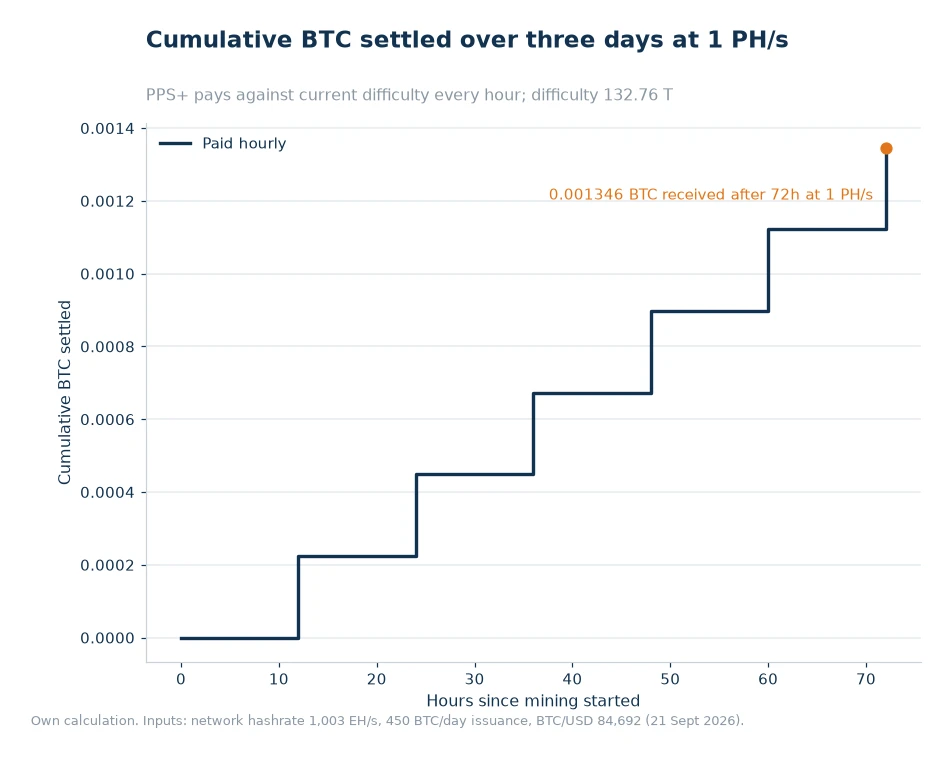
For a farm rather than a single machine, the question shifts from eligibility to cadence. PPS+ settles against current difficulty every hour, so a 1 PH/s operation sees roughly 0.0000187 BTC an hour, about $1.58, and 0.0013464 BTC across three days of steady hashing. That steady arrival is what makes a paid charge easy to absorb: the fee for a single transaction is a couple of hours of output, not a capital event.
| Charge in BTC | USD equivalent | In LTC | In BCH | Hours of 1 PH/s output |
|---|---|---|---|---|
| 0.00002 BTC | $1.69 | 0.0286 LTC | 0.0065 BCH | 1.1 hours |
| 0.00003 BTC | $2.54 | 0.0428 LTC | 0.0097 BCH | 1.6 hours |
| 0.00004 BTC | $3.39 | 0.0571 LTC | 0.0130 BCH | 2.1 hours |
| 0.00005 BTC | $4.23 | 0.0714 LTC | 0.0162 BCH | 2.7 hours |
Note what the last column does to the decision. A farm holding a working balance measured in hours of output does not need to think about the size of the charge, only about whether the transaction is eligible. That is the correct order of operations: eligibility first, price second, currency third.
Two scenarios compared
Scenario one: pay in BTC from mining proceeds. The charge is debited from the BTC balance, the transaction is queued for the next block mined by the pool, and the account's BTC position is $3.39 lighter. Nothing extra is broadcast, so there is no second transaction to confirm and no second fee to pay.
Scenario two: pay in LTC or BCH. The same $3.39 leaves the account as 0.0571 LTC or 0.0130 BCH, and the BTC balance stays whole. For an operator who intends to hold BTC for the long term and treat merged-mining altcoin income as working capital, this is the cheaper arrangement in opportunity terms even though the dollar amount is identical. The 24-hour difference between the two scenarios is zero in fees and non-zero in what you still own.
Both scenarios share one constraint that is easy to miss: the chosen asset has to be in the account before you submit. A submission that cannot be funded is not a queue position, and by the time the balance lands, the mempool you were trying to beat may have changed. Keeping the balance topped up is worth a five-minute weekly check on a mining pool dashboard that shows both hashrate and settled income.
Where the stuck transaction is part of a chain, the eligibility rule overrides everything else, and it is worth repeating because it catches so many people: a transaction containing unconfirmed inputs cannot be accelerated at all, and the correct move is to accelerate the parent first. Submitting the parent through the ViaBTC TX Accelerator is the paid version of that fix, and it is available in any of the three accepted currencies, so an operator who holds only LTC is not locked out by a BTC-only policy.
Common failure modes
- Submitting a child first. Unconfirmed inputs disqualify the transaction. Work back to the oldest unconfirmed parent and submit that one.
- Assuming a submitted request can be undone. It cannot be cancelled and the charge is not refunded, which is why the eligibility check belongs before the submission, not after.
- Attempting a replacement. Double-spend transactions are outside the supported scope, so a fee bump that spends the same coins again is a dead end.
- Choosing an asset with no balance. The charge is deducted from account assets; the currency you pick has to be there, and an unfunded submission fixes nothing.
- Ignoring the size cap. A consolidation over 0.5 KB never enters the free quota regardless of its fee rate, so accidental sweeps are the most expensive habit in this whole workflow.
- Forgetting that free quota refreshes hourly. Requests are processed in submission order, so the free slot you missed at 14:00 is available again at 15:00 — worth waiting for when the transaction is not urgent.
Frequently asked questions
Is a bigger pool always better?
Size reduces payout variance but also concentrates hashrate. What matters more is fee structure, uptime, latency and payout cadence.
What happens if my miner goes offline?
Shares stop, so expected income stops with them. Alerts and a dashboard that shows per-worker hashrate shorten the gap between a failure and a fix.
Which currency should I use to pay an acceleration charge?
Whichever one you already hold and would otherwise convert. The dollar value of the charge is identical in BTC, BCH and LTC; only the asset you part with differs, along with the conversion cost you avoid by not selling first.
Decide before you submit
Three checks settle almost every case: is any input still unconfirmed, is the transaction inside 0.5 KB, and is its fee rate at or above 0.0001 BTC/KB. If all three are yes, the free quota is the first stop. If any is no, the paid path in BTC, BCH or LTC is the fallback, and a working balance covering a few hours of hashrate settles it. Rehearse that sequence once and a stuck transaction stops being an emergency.
Data and sources: ViaBTC transaction accelerator documentation for accepted currencies, the eligibility thresholds and the no-cancellation rule[1], and the ViaBTC wallet page for account balances and auto conversion[2]. Network difficulty (132.76 T), hourly settlement, BTC $84,692, LTC $59.32 and BCH $261.48 were read on 21 September 2026. Charges shown are illustrative; figures are rounded and move with price and mempool conditions.