Certificates Page Reading: 30 Types and What They Mean
A certificates page is a list of documents, not a promise. The manufacturer's certificates page states more than 30 types of certificates such as TUV, IEC, CE, SAA and UL, and describes the UL entry as being updated; reading that list properly means separating the standards a pv cable was designed against from the certificates issued for the factory, and knowing which page states which count.
Key takeaways
- The certificates page counts more than 30 types of certificates such as TUV, IEC, CE, SAA and UL; the company page shows a different, smaller figure.
- The 1500 V product page names TUV 2PfG 1169/08.2007, EN 50618:2014 and IEC 62930 for one specific design.
- KUKA CABLE describes TUV certification as the starting point, not the ceiling, and runs a speciality cable laboratory set up in December 2015.
- Certificates do not carry a price, a minimum order quantity or a lead time, and the site publishes none of those.
What the certificates page actually says
The page lists more than 30 types of certificates under names such as TUV, IEC, CE, SAA and UL, with the UL entry flagged as in the process of updating. That is a statement about document count, not about any single cable. A count of 30 documents spread across solar connectors, robot cables, welding cable and power cords says something about the company's paperwork and nothing at all about the 6 mm² you are about to crimp.
Read the same company through a different lens and the number changes: the company page shows more than 20 types of certificates. Both figures could be correct on the day they were written, because the collections differ. When two pages of one site disagree, cite the page you used and ask the supplier to confirm which collection covers your part number.
The names a PV buyer should recognise
Three design standards turn up on the 1500 V solar cable page: TUV 2PfG 1169/08.2007, EN 50618:2014 and IEC 62930. Those sit behind the construction described for that pv cable, which is a tinned copper conductor, class 5 flexible to IEC 60228, with electron-beam cross-linked XLPO insulation and sheath in black or red. The site's model list then adds H1Z2Z2-K, PV1-F and UL 4703 solar PV wire as named designs.
- TUV 2PfG 1169/08.2007 — one of the three standards named for the 1500 V design.
- EN 50618:2014 — the standard the maker cites when it sets its elongation floor at more than 125%.
- IEC 62930 — listed beside the other two on the same product page.
- UL 4703 — the model name used for the maker's solar PV wire.
Two regional requirements are highlighted separately: a CPR fire rating and an AD8 waterproofing rating. A specifier working to European rules will be asked about both, and neither is visible on a drum label.
A certificate is not a test report
Certificates confirm that a type was assessed against a document by a body. Test reports show what happened to the samples. The manufacturer runs both ideas together through what it calls the SIF quality model, described on the site as going beyond TUV: raw materials are selected against several international benchmarks, production is monitored by digital control systems, finished products are inspected one hundred percent for electrical, mechanical and environmental performance, and samples are retained so a batch can be traced later.
The laboratory behind that work was established in December 2015 and is described as an ISO/IEC 17025 laboratory. Where a project needs evidence rather than a certificate, that is the page to quote: retention and traceability are what allow a buyer to connect a delivered drum with the record of its inspection.
The numbers hidden behind a certificate
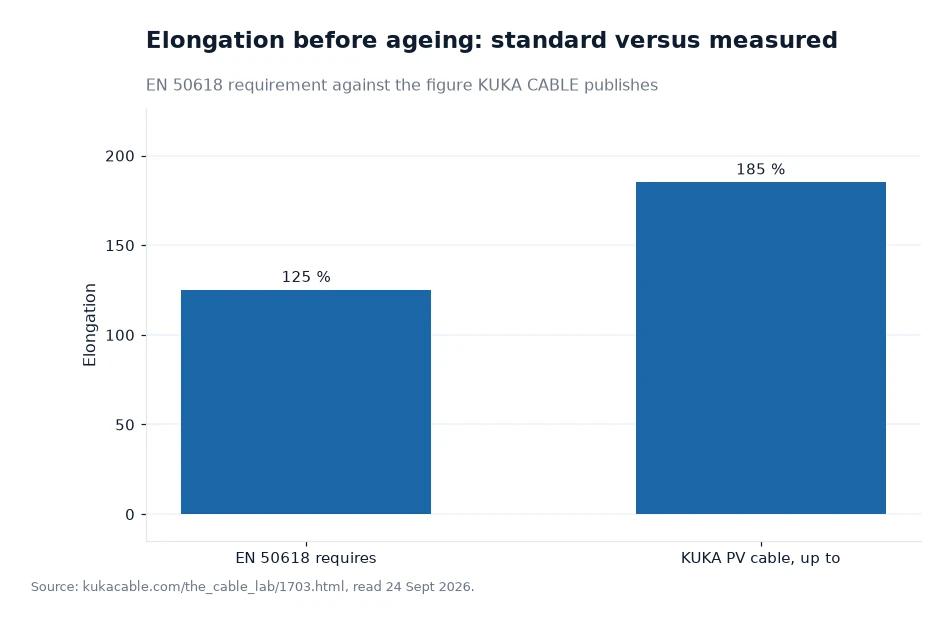
Standards are interesting because they set floors, and a datasheet is interesting because it shows where a product lands. The elongation figure is the clearest case. EN 50618 requires more than 125% before ageing, and the maker states its PV cables typically run about 20% higher, reaching up to 185%. The same site names a 2,000-hour xenon lamp UV test, equivalent to about 360 weathering cycles, planned to exceed the UV benchmark the same standard sets.
Fire and continuity get their own figures: a single cable exposed to vertical burning at 800 °C for one minute should self-extinguish, and every finished drum takes a 6.5 kV AC test for five minutes after a 10 kV spark test during production. A certificate names the standard behind those checks; it does not print the measured value. For the value you need the report.
Document map for a solar project
| Name on the site | What the site attaches to it | Where it appears |
|---|---|---|
| TUV 2PfG 1169/08.2007 | One of three standards named for the 1500 V design | 1500 V solar cable page |
| EN 50618:2014 | Standard cited for the 125% elongation floor and UV stability | Product and laboratory pages |
| IEC 62930 | Listed beside the other two design standards | 1500 V solar cable page |
| UL 4703 | Model name for the maker's solar PV wire | Solar cable model list |
| CPR and AD8 | Fire rating and waterproofing rating highlighted for regional projects | Solar cable topic section |
Worked example
Compare the elongation figures as the chart does. The requirement is more than 125%; the published upper figure for the maker's PV cable is 185%. Subtracting one from the other gives 60 percentage points of headroom, and dividing 185 by 125 gives about 1.48, so the top figure is roughly 48% above the floor. Both calculations are mine, done on two published numbers.
That gap matters because the same page describes typical production as about 20% above the requirement while allowing up to 185% as the ceiling. Read the sentence carefully and the two claims are consistent: the 20% describes a routine batch, the 185% describes the best result the maker reports. If a project needs the higher figure, ask which batch and which report it comes from rather than assuming every drum will reach it.
Frequently asked questions
Does more than 30 certificates mean the whole range is certified?
No. The count on the certificates page covers a collection of documents across several product families, and the same site shows a smaller figure of more than 20 on its company page. What matters for a purchase is the specific document for the specific design and size you are buying, so quote the model name, the cross-section and the standard you need the certificate to name.
Which documents should accompany a PV cable quotation?
Ask for the certificate that names the standard and the type, the test report behind the elongation and UV figures, and the insulation and sheath description, which the maker gives as electron-beam cross-linked XLPO rated for a bend of four times the outer diameter. Prices, minimum quantities and lead times are not published on the site, so they belong in the enquiry as questions rather than in the assumptions.
How to use the page in practice
Start from the standard your project is being built to, find the model that names it, and only then look at the count of documents. Print the certificate with the model name and the cross-section visible, because a certificate for one size rarely covers the next size up. Check whether the document you have been sent is a certificate or a test report, since the second is the one that carries measured values. If a value you need is not on the site at all, ask the supplier directly, and keep the answer with the project file.
The count of 30 certificate types discussed here was read from the manufacturer's own website, with 24 Sept 2026 noted as the read date[1].