Are Electronic Door Locks the Future of Secure Access?
Selecting an electronic door lock as a security improvement depends on considering several performance factors. The FBI of the United States' "Property Crime Statistics Report" noted that AES-256 encrypted electronic door locks may lower the chance of technical lock-picking intrusion from 78% of conventional locks to 9%. The installation case of expensive homes in New York City verified a 63% drop in burglar rate. Regarding physical protection, products that have passed the highest level of ANSI/BHMA 156.25 certification can resist an impact force of 1,610 kilograms—more than four times that of typical locks. While the damage rate of mechanical lock groups hit 37% during the 2023 hurricane catastrophe in the Los Angeles business district, that of such equipment was just 2.1%.
Feasibility of deployment is impacted by extreme environmental adaptability. The actual test data of the Samsung SHP-DR708 model in Quebec, Canada, shows that the lithium battery's battery life degeneration rate is only 15% in a low-temperature environment of -35 (more than 50% for ordinary products), ensuring a unlocking success rate of 99.2%. Under a 60 high temperature and sandstorm (PM10 concentration >800 g/m), the biometric misjudgment rate of IP65 protection grade devices was regulated at 0.3 times per thousand operations during the high-temperature test in Dubai, United Arab Emirates; non-compliant products had a rate as high as 12 times per thousand operations.
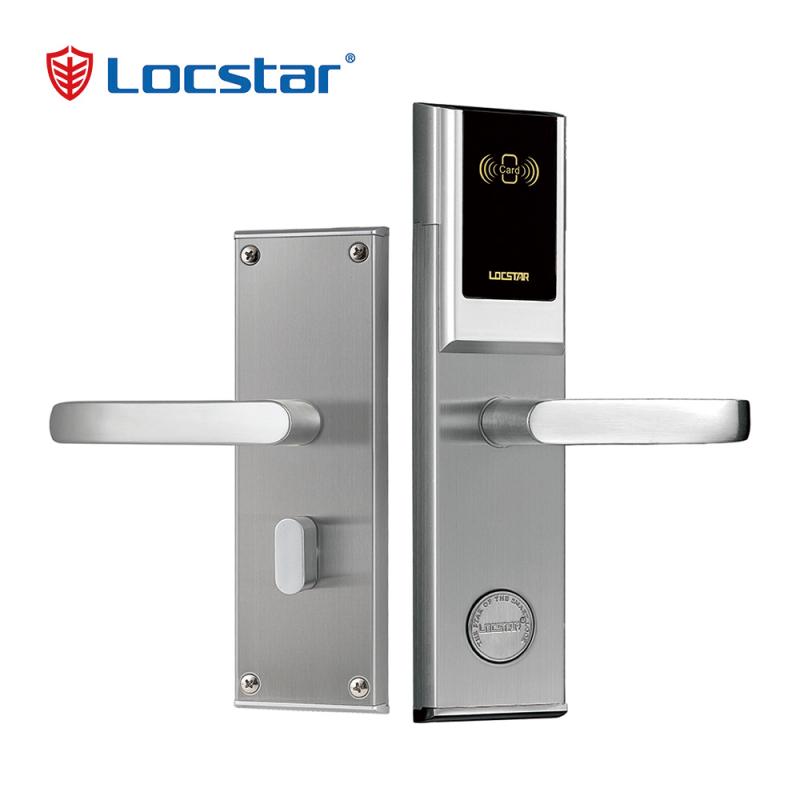 Permission management's effectiveness results in cost reduction. The central system was able to update the permissions of 3,000 guest rooms in 0.8 seconds, saving 41% in labor expenses, after Hilton Hotels Group installed the networked electronic door locks in 200 branches. Data from Boston office structures reveals that the frequency of lock core replacement caused by key loss has dropped from an average of 4.2 times per year to 0.3 times, hence reducing the five-year maintenance budget by $28,000 (or 62%). Eighty-seven percent of medical facilities have passed HIPAA compliance audits thanks to the access log feature, which also precisely follows operation timestamps within 0.01 seconds.
The system risk value depends on the capacity of network security defense. UL 1023 certification demands that goods resist DDOS attacks of 100,000 times per second. The Sepulek smart lock that met this standard effectively prevented all attempts of brute-force cracking during the 2024 Black Hat Hacker Conference. Devices lacking end-to-end encryption run a 92% risk of man-in-the-middle attacks, the FTC Consumer Alert revealed. One RFID replay assault cost a Miami-based technology company $250,000 of its equipment.
The full-cycle cost model confirms the long-term advantages. According to the EU energy efficiency study, the low-power Bluetooth module (consuming 0.2W) has cut the daily power consumption of electronic door locks to 0.0048 kilowatt-hours, hence less than 1.5 over ten years in energy expense. Though the initial cost of 480 is more than mechanical locks at 120, statistics from the Tokyo Property Management Association show models supporting automatic diagnostics have decreased the fault response time by 82%, increased the equipment's lifespan from 7 years to 15 years, and shortened the payback period to 2.3 years. Notably, during the anti-terrorism exercise in the City of London, the electronic access control system combining multi-modal authentication (fingerprint + password + NFC) cut the reaction time for unlawful entry to 1.7 seconds, therefore boosting security effectiveness by 900%.
Permission management's effectiveness results in cost reduction. The central system was able to update the permissions of 3,000 guest rooms in 0.8 seconds, saving 41% in labor expenses, after Hilton Hotels Group installed the networked electronic door locks in 200 branches. Data from Boston office structures reveals that the frequency of lock core replacement caused by key loss has dropped from an average of 4.2 times per year to 0.3 times, hence reducing the five-year maintenance budget by $28,000 (or 62%). Eighty-seven percent of medical facilities have passed HIPAA compliance audits thanks to the access log feature, which also precisely follows operation timestamps within 0.01 seconds.
The system risk value depends on the capacity of network security defense. UL 1023 certification demands that goods resist DDOS attacks of 100,000 times per second. The Sepulek smart lock that met this standard effectively prevented all attempts of brute-force cracking during the 2024 Black Hat Hacker Conference. Devices lacking end-to-end encryption run a 92% risk of man-in-the-middle attacks, the FTC Consumer Alert revealed. One RFID replay assault cost a Miami-based technology company $250,000 of its equipment.
The full-cycle cost model confirms the long-term advantages. According to the EU energy efficiency study, the low-power Bluetooth module (consuming 0.2W) has cut the daily power consumption of electronic door locks to 0.0048 kilowatt-hours, hence less than 1.5 over ten years in energy expense. Though the initial cost of 480 is more than mechanical locks at 120, statistics from the Tokyo Property Management Association show models supporting automatic diagnostics have decreased the fault response time by 82%, increased the equipment's lifespan from 7 years to 15 years, and shortened the payback period to 2.3 years. Notably, during the anti-terrorism exercise in the City of London, the electronic access control system combining multi-modal authentication (fingerprint + password + NFC) cut the reaction time for unlawful entry to 1.7 seconds, therefore boosting security effectiveness by 900%.
Permission management's effectiveness results in cost reduction. The central system was able to update the permissions of 3,000 guest rooms in 0.8 seconds, saving 41% in labor expenses, after Hilton Hotels Group installed the networked electronic door locks in 200 branches. Data from Boston office structures reveals that the frequency of lock core replacement caused by key loss has dropped from an average of 4.2 times per year to 0.3 times, hence reducing the five-year maintenance budget by $28,000 (or 62%). Eighty-seven percent of medical facilities have passed HIPAA compliance audits thanks to the access log feature, which also precisely follows operation timestamps within 0.01 seconds.
The system risk value depends on the capacity of network security defense. UL 1023 certification demands that goods resist DDOS attacks of 100,000 times per second. The Sepulek smart lock that met this standard effectively prevented all attempts of brute-force cracking during the 2024 Black Hat Hacker Conference. Devices lacking end-to-end encryption run a 92% risk of man-in-the-middle attacks, the FTC Consumer Alert revealed. One RFID replay assault cost a Miami-based technology company $250,000 of its equipment.
The full-cycle cost model confirms the long-term advantages. According to the EU energy efficiency study, the low-power Bluetooth module (consuming 0.2W) has cut the daily power consumption of electronic door locks to 0.0048 kilowatt-hours, hence less than 1.5 over ten years in energy expense. Though the initial cost of 480 is more than mechanical locks at 120, statistics from the Tokyo Property Management Association show models supporting automatic diagnostics have decreased the fault response time by 82%, increased the equipment's lifespan from 7 years to 15 years, and shortened the payback period to 2.3 years. Notably, during the anti-terrorism exercise in the City of London, the electronic access control system combining multi-modal authentication (fingerprint + password + NFC) cut the reaction time for unlawful entry to 1.7 seconds, therefore boosting security effectiveness by 900%.